.webp)
TLDR: The main difference between open and closed rhinoplasty lies in the surgical access. Open rhinoplasty uses a small incision at the base of the nose to provide a direct view of the internal nasal structures. Closed rhinoplasty places all incisions inside the nostrils and leaves no external scars. The choice between them depends on the complexity of the case and the surgeon's judgment, not on a universal rule.
When a patient leaves my consultation and spends time researching online, they almost always come back with the same question: "Doctor, which is better, open or closed?" I understand why people ask this. When making such an important decision, you want a clear answer.
What I am going to do here is give you that clarity, while being completely honest about how this actually works in practice. If you are still not sure whether what you need is an open, closed, ethnic, or revision rhinoplasty, I recommend reading this overview of the different types of rhinoplasty before continuing with this comparison.
Surgical access during rhinoplasty
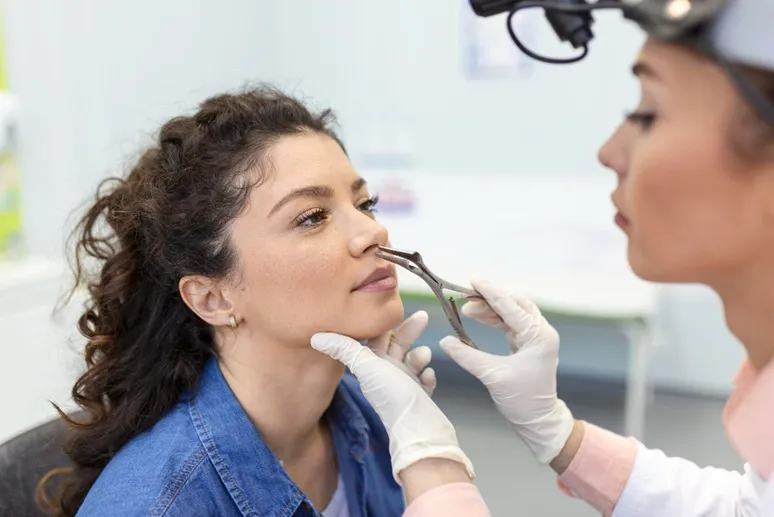
The fundamental difference between both techniques is how the surgeon accesses the internal structures of the nose.
In open rhinoplasty
An incision is made on the columella, that small strip of skin between the two nostrils. That incision allows the surgeon to lift the nasal skin upward, leaving the internal architecture clearly exposed. The surgeon can directly see the cartilages, the septum, and the nasal bones. That direct visibility is the major advantage of this approach.
In closed rhinoplasty
All incisions are made inside the nostrils. There is no external cut. The surgeon works through those internal access points, sometimes using specialized instruments, to modify the nasal structures. The absence of an external scar is the immediate advantage patients mention most.
What direct visualization means for rhinoplasties
Working with a direct view, as in open rhinoplasty, allows the surgeon to assess and modify the nasal architecture with greater precision in complex cases. If the nasal tip has asymmetry, if cartilages are poorly positioned, if grafts need to be placed accurately, the broad exposure facilitates the work considerably. The American Society of Plastic Surgeons notes that open rhinoplasty is particularly valued by surgeons in cases requiring precise manipulation of multiple nasal structures simultaneously.
In closed rhinoplasty, the surgeon works with more limited access. For a surgeon with extensive experience in this technique, that limitation is not an issue in cases that are appropriate for this approach. But in more complex cases, forcing a closed technique can compromise the precision of the result.
The scar issue for open rhinoplasty
I know this point generates significant anxiety, so I want to be clear. The scar from open rhinoplasty is located on the columella, at the base of the nose. It is a small scar, typically shaped like a narrow "V" or "W." It is placed in an area that is practically invisible from the front or in profile. And in the vast majority of cases, with adequate healing time and proper postoperative care, it becomes very difficult to notice.
The concern about this scar is understandable. But in my clinical experience, patients who undergo open approach surgery rarely mention it as a problem in follow-up visits.
Recovery time in closed rhinoplasty
In general terms, closed rhinoplasty tends to produce less initial swelling and the recovery period can be somewhat shorter. This is because there is less soft tissue dissection.
However, the difference in recovery time between both techniques has narrowed with advances in surgical methods. In both cases, the most visible swelling typically resolves within two to four weeks. The final result, with swelling completely gone, can take up to twelve months to consolidate. The Cleveland Clinic notes that in some patients, particularly those with thicker skin, full tip definition may take up to eighteen months to appear. This is completely normal and is something I always explain to patients before surgery.
How do I choose between open rhinoplasty and closed rhinoplasty?
The choice between open and closed rhinoplasty is made by the surgeon based on three main factors: the anatomical complexity of the case, the type of changes the patient wants to achieve, and the specialist's experience and technical preference.
There are excellent surgeons who prefer the closed technique for most of their cases because they have a very high level of mastery of that approach. There are equally excellent surgeons who prefer the open approach for the precision it offers. Neither is wrong. What matters is that the chosen approach is the most appropriate for your specific case.
If you are in the process of evaluating your rhinoplasty options, the first step is to speak with a specialist who can analyze your anatomy and explain which technique they recommend for you and why. Through Kurbuo, you can connect with rhinoplasty specialists through a medical virtual consultation, without needing to travel first. That initial conversation gives you the real information you need to move forward with confidence.
.webp)



.webp)