
Prostate Cancer Treatment in Latin America: Complete 2026 Guide for U.S. Patients
A prostate cancer diagnosis can change a man’s life in a matter of seconds. Suddenly, questions appear that most men never expected to face: How serious is it? Do I need surgery? What will it cost? Will I recover fully?
If you are reading this, you have likely already received a diagnosis or are currently evaluating your options.
One important thing to understand is that you do not have to face this decision alone — and you are not limited to a single treatment option.
Prostate cancer is the most common cancer among men in the United States. According to the American Cancer Society, approximately 1 in 8 men will be diagnosed with prostate cancer during their lifetime.
The good news is that survival rates are very high when the disease is detected early.
The challenge for many patients, however, is the cost of treatment in the United States. Surgical procedures alone can exceed $40,000, not including radiation therapy, imaging, medications, and long-term follow-up care.
Because of this, an increasing number of U.S. patients are exploring treatment options in Latin America, where internationally trained urologic oncologists perform the same procedures using the same technology — often at 40–70% lower cost.
This guide provides clear, evidence-based information about prostate cancer treatment options in Latin America so you can make the best decision for your health and your future.
This article is informational and does not replace medical advice. Always consult your physician before making treatment decisions.
Why U.S. Patients Are Considering Prostate Cancer Treatment in Latin America
Several factors are driving interest in international treatment options:
High medical costs in the United States
Robotic prostate surgery alone may cost $25,000–$40,000, depending on the hospital.
High deductibles and out-of-pocket costs
Many patients with insurance still face $5,000–$10,000 deductibles.
Comparable technology and specialists abroad
Leading hospitals in Colombia and Mexico use the same Da Vinci robotic systems used in top U.S. hospitals.
Shorter waiting times
In many cases, treatment can be scheduled within weeks.
What Is Prostate Cancer? Understanding the Basics Before Choosing a Treatment
Prostate cancer occurs when abnormal cells develop in the prostate gland, which is part of the male reproductive system.
Most prostate cancers grow slowly, but some types can be aggressive and spread to other parts of the body.
Early detection is typically made through:
- PSA blood tests
- MRI imaging
- Prostate biopsy
Understanding your Gleason score and cancer stage is essential for determining the most appropriate treatment.
Understanding the Gleason Score and What It Means for Your Treatment Options
After a biopsy, the pathologist assigns a Gleason Score, which indicates how aggressive the cancer cells appear.
Scores range from 6 to 10.
Gleason 6 (Grade Group 1)
Low-risk cancer.
Cells resemble normal prostate cells and grow slowly.
Treatment may include:
- Active surveillance
- Surgery
- Radiation therapy
Gleason 7 (Grade Groups 2–3)
Intermediate risk cancer.
Subcategories include:
3+4 – more favorable
4+3 – more aggressive
Treatment typically involves:
- Robotic prostatectomy
- Radiation therapy
- Combination therapy
Gleason 8–10 (Grade Groups 4–5)
High-risk cancer.
These tumors are more aggressive and often require multidisciplinary treatment.
Stages of Prostate Cancer: Which Cases Can Be Treated in Latin America?
Stage I
Small tumor confined to the prostate.
Excellent prognosis.
Stage II
Cancer remains confined to the prostate but may be detectable during examination.
Stage III
Cancer has spread beyond the prostate capsule.
Stage IV
Cancer has metastasized to lymph nodes, bones, or other organs.
Who Is a Good Candidate for Prostate Cancer Treatment Abroad?
Many patients with localized or moderately advanced prostate cancer can safely travel for treatment.
Typical candidates include patients with:
- Gleason 6–7 disease
- Stage I–II prostate cancer
- Early Stage III cancer
- Biochemical recurrence after surgery
When Traveling for Prostate Cancer Treatment Is Not Recommended
Travel for treatment may not be advisable in the following situations:
Metastatic prostate cancer (Stage IV)
Advanced disease requires ongoing systemic therapy and close monitoring.
Severe cardiovascular disease
Acute urinary obstruction
Patients actively undergoing chemotherapy or radiation therapy
Your safety must always come first.
Prostate Cancer Treatment Options Available in Latin America
Leading medical centers in Colombia and Mexico offer the same modern treatments available in the United States.
These include:
- Robotic prostatectomy
- Radiation therapy
- Brachytherapy
- Hormone therapy
- Active surveillance programs
Robotic Prostatectomy in Latin America: Da Vinci Surgery for Prostate Cancer
Robotic prostatectomy is currently considered the gold standard surgical treatment for localized prostate cancer.
The procedure uses the Da Vinci robotic system, allowing surgeons to operate through very small incisions with exceptional precision.
Benefits include:
- Less blood loss
- Reduced pain
- Shorter hospital stay
- Faster recovery
- Better preservation of urinary continence
- Improved chances of maintaining sexual function
Many hospitals in Bogotá, Medellín, Mexico City, Monterrey, and Guadalajara use this technology.
Open and Laparoscopic Prostatectomy: Alternative Surgical Approaches
In some cases, robotic surgery may not be the best option.
Alternative procedures include:
Open prostatectomy
Traditional surgery with direct access to the prostate.
Laparoscopic prostatectomy
Minimally invasive surgery using small incisions and specialized instruments.
Radiation Therapy for Prostate Cancer in Latin America (IMRT and IGRT)
Radiation therapy is another highly effective treatment.
Modern techniques include:
IMRT — Intensity-Modulated Radiation Therapy
IGRT — Image-Guided Radiation Therapy
These technologies allow precise targeting of cancer cells while protecting surrounding tissue.
Treatment usually requires 20–40 sessions over several weeks.
Brachytherapy for Prostate Cancer: A Minimally Invasive Option
Brachytherapy involves implanting small radioactive seeds directly into the prostate.
Advantages include:
- Minimally invasive procedure
- Often completed in a single session
- Quick recovery
It is particularly effective for low-risk and favorable intermediate-risk prostate cancer.
Active Surveillance for Low-Risk Prostate Cancer
Not all prostate cancers require immediate treatment.
Active surveillance involves:
- Regular PSA monitoring
- MRI imaging
- Periodic biopsies
Treatment is initiated only if the cancer progresses.
Hormone Therapy for Prostate Cancer: When It Is Used
Hormone therapy lowers testosterone levels to slow cancer growth.
It may be used:
- With radiation therapy
- Before radiation
- For advanced disease
Common medications include:
- Leuprolide
- Goserelin
- Enzalutamide
- Abiraterone
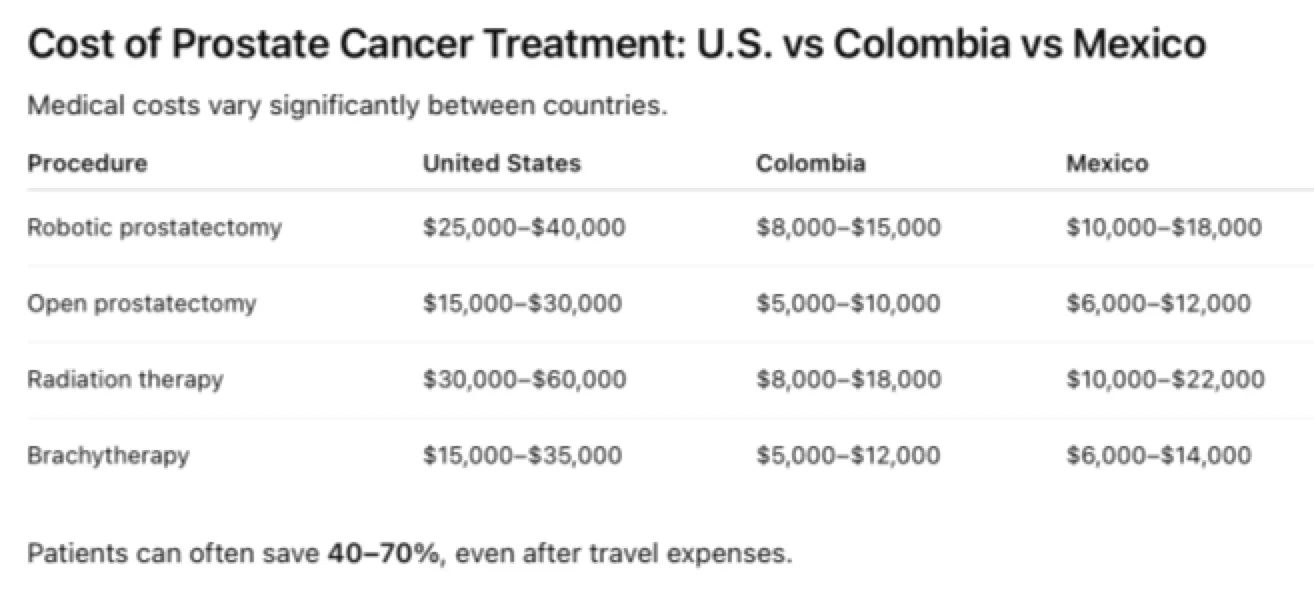
Cost of Prostate Cancer Treatment: U.S. vs Colombia vs Mexico
Medical costs vary significantly between countries.
Is Prostate Cancer Treatment in Latin America Safe?
One of the most common concerns is quality and safety.
In accredited hospitals with experienced surgeons, treatment outcomes are comparable to many U.S. centers.
Da Vinci Robotic Technology in Colombia and Mexico
The Da Vinci robotic system is manufactured by Intuitive Surgical in California and used worldwide.
A Da Vinci system in Latin America is the exact same machine used in U.S. hospitals.
Hospital Accreditations and International Quality Standards
Many hospitals in Latin America maintain international certifications, including:
Joint Commission International (JCI)
One of the most recognized global healthcare accreditation systems.
Training and Credentials of Urologic Oncologists in Latin America
Many specialists have completed advanced training or fellowships in:
- Cleveland Clinic
- Johns Hopkins
- European university hospitals
Many are members of:
- American Urological Association
- European Association of Urology
How KURBUO Verifies Doctors and Medical Centers
Every specialist in the KURBUO network undergoes a verification process including:
- Medical license validation
- Specialty certification review
- Surgical training verification
- Professional background checks
What the Treatment Process Looks Like with KURBUO
KURBUO provides a structured process designed to help international patients navigate treatment safely.
Step 1: Schedule a Free Tele-Consultation with a Verified Urologist
The process begins with a virtual consultation where a specialist reviews your case.
Step 2: Get a Personalized Case Evaluation
Your specialist will determine whether treatment abroad is appropriate.
Step 3: Receive Your Treatment Plan and Cost Estimate
You receive:
- Recommended treatment
- Cost estimate
- Timeline
- Hospital assignment
Step 4: Travel and Receive Treatment at an Accredited Hospital
Upon arrival:
- Airport pickup
- Bilingual support
- Treatment at an accredited hospital
Hospital stay after robotic prostatectomy is typically 1–2 days.
Step 5: Post-Treatment Follow-Up and Coordination with Your U.S. Urologist
Before returning home you receive:
- Surgical report
- Pathology results
- Follow-up instructions
Your specialist remains available for virtual consultations.
Frequently Asked Questions About Prostate Cancer Treatment in Latin America
Is robotic surgery available in Latin America?
Yes. Many hospitals in Colombia and Mexico use the Da Vinci robotic system.
How long do I need to stay for surgery?
Most patients stay 10–14 days.
Will my U.S. doctor be involved after surgery?
Yes. Follow-up PSA monitoring is typically coordinated with your physician at home.
Take the First Step: Speak with a Verified Urologist at KURBUO
Facing prostate cancer is challenging, but having the right information can make the decision process easier.
A KURBUO tele-consultation is free, confidential, and carries no obligation.
It simply allows you to speak with a specialist and understand all your treatment options.
Schedule your consultation: KURBUO
WhatsApp
+1 (689) 222-7585